Entering the Writer’s Alternate Reality

writing[1]I felt tremendous joy and satisfaction this week watching my second novel, A WAY OUT OF HELL, pop up on Amazon.com! Nearly two years of work finally ready to be shared with the world. But if writing a novel is difficult, for me getting the word out to people is much more of a challenge. As my daughter reminds me often, she has 10x as many followers on Facebook as I do. A huge THANKS to any readers who want to help me by passing the word along to others!!

I want to thank my wife for supporting me to write, even though she’s not a big fan of the process. When we get together at dinner, her stories are generally about comforting abused kids, hugging a prostitute, or praying for a naked crazy person on the street. My wife smells a crisis a mile away and wants to be the first to jump in and love somebody who’s hurting.

Then I tell her about my day, with stories equally dramatic, heart-felt and amazing—except they’re not real. I get all teary-eyed about what my fictional character said to her mother, or worried about how my hero is going to get out of the desperate corner I’ve written him into. My wife just stares at me. And if I talk too long, she reminds me that fiction is boring and I should engage in real people’s lives.

One benefit of these conversations is that her real-life stories creep into my book, lending it a realistic authenticity. Another benefit is that when I’m writing, she literally has no interest in bugging me so I get a lot done. But best of all, is that I actually do get inspired by her to stretch my introvert self and once in a while join her “holy, holy chaos.”

I’m sure different authors approach writing differently. For me so far, each book has started with a message I wanted to share, something I believe could truly change my readers’ paradigms. Around the message I built a story about characters wrestling with these issues.

Sometimes halfway through the story, the characters begin to take on a life of their own, and want to take the story to new places I hadn’t planned. I always listen to them, and let them lead. I may be their Creator, but it’s so much more interesting to give them Free Will and see what might happen. 🙂

In both of my books so far that phenomena has occurred, and I’m finding it even more a reality in the third book of the series that I’m editing right now. With God’s help (and some capable friends!) book #3 in the Peace Trilogy will be out by Christmas.

Whether a story is real or fiction, narrative carries the emotive power necessary to open our minds to fresh ways of thinking, to inspire us to take new risks, to envision us with what could be.

Thank you for reading my stories! Please post your feedback for me here or at Amazon.com.

(And if you ever purchase a defective book online, just let me know and I’ll get you a replacement! 🙂 )

The Jihad of Jesus

The Jihad of Jesus book cover   I remember well the Q&A session in one of the many interfaith events we’ve organized over the years. An angry Christian stood up and declared, “As long as the word jihad exists, there will never be peace between our two religions!” The room was deathly silent, demanding the right response given in the right spirit.

From the platform, one of the speakers, the Orthodox Christian Bambang Noorsena, looked at his dear Muslim friend and presenter next to him, and said, “Let me answer this question.

“The term jihad is a perfectly wonderful term found not only in the Al Qur’an, but also in the Bible.” The audience was shocked. Bambang then quoted a verse from his Arabic New Testament about our “struggle” in the faith. I can’t recall which verse he quoted, since there are more than 10 mentions of jihad in the New Testament, but it might have been one of these:

“I’m passing this work on to you, my son Timothy. The prophetic word that was directed to you prepared us for this. All those prayers are coming together now so you will do this well, fearless in your struggle, keeping a firm grip on your faith and on yourself. After all, this is a fight [jihad] we’re in.” I Timothy 1:18, The Message

“This is no afternoon athletic contest that we’ll walk away from and forget about in a couple of hours. This is for keeps, a life-or-death fight to the finish [jihad] against the Devil and all his angels.” Ephesians 6:12 The Message

“I have fought the good fight [jihad], I have finished the race, I have kept the faith.” 2 Timothy 4:7 NIV

There is a “holy struggle” we all engage in—not against people who are different than we are—but against worldly values, temptations to our flesh and the devil. In Indonesia, we’ve actually published a book called True Jihad which shows from the Al Qur’an that jihad today should only be fought against the world, the flesh and the devil! There are many Muslims who believe and practice this positive understanding of jihad.

But the best book I’ve ever read on the topic is Dave Andrew’s The Jihad of Jesus. His book allows us to look in the mirror as both Christians and Muslims at how our “holy wars” have gotten away from God’s desire for us to struggle with faith, hope and love. Then he shares the struggle we should all be on.

>>For Muslims, it’s struggling to live out the Bismillah ir-Rahman ir-Rahim (“In the name of God, the most Merciful, Most Compassionate”). This declaration of who God is begins every chapter but one in the Al Qur’an, and is recited countless times a day by the faithful. One Muslim told Dave he strives to interpret every passage of the Al Qur’an “consistent with the grace and compassion of God.” What if in every relationship, Muslims reflected God’s character of mercy and love?

>>For Christians, it’s struggling to follow Jesus—to love God, neighbor and enemy as Jesus first loved us. What if Christians put all other religious activities second to that? Dave presents a beautiful quote from Khalid Muhammad Khalid’s work Ma’an ‘ala-l-Tariq: Muhammad wa–i-Masih (p.52): “Christ was himself the message. He was the supreme example he left. He was the love which knows no hatred, the peace which knows no restlessness, the salvation which knows no perishing. And when we (Christians and Muslims—together) realize all these things on this earth, we shall then comprehend the return of the Christ.”

My early candidate for Book of the Year—you can find it at Amazon or even hear Dave share his amazing stories of peacemaking at www.jihadofjesus.com,

Buy at Amazon: The Jihad of Jesus: The Sacred Nonviolent Struggle for Justice

Is Jesus the “Son of God”?

Jesus statue Rio   Recently I was having a meal in my home with a Muslim brother who often quotes the Bible to me and has a high honor for Jesus. I loved his openness to talk about Jesus, and wanted him to know that at least some of the differences between how Muslims and Christians talk about Jesus (not all) have their roots in historic and linguistic differences.

So I began to share about the phrase “son of God,” which is so difficult for Muslims to accept. The Qur’an clearly states that God cannot have a walad, or a biological offspring. Of course, all Christians would agree—Jesus’ sonship has nothing biological about it. So why did the Qur’an emphasize this point?

In the era of the Prophets of Israel, everyone was looking forward to the coming Messiah. He would be the “Anointed One,” the King who ushers in God’s Kingdom, the offspring of King David.

This concept of a King anointed by God to rule invoked a special relationship with God, which God chose to describe as a “Father-Son” relationship. In Psalm 89:20-27, we read that God called David his “firstborn,” and that David was to call God “Father.” This is even clearer in the case of Solomon, where God declares:

“I will be his a¯b (father), and he shall be my ben (son).”

Did you realize Jesus was not the first person to be called God’s son? But as Messiah, and rightful King, God spoke from the sky a similar pronouncement over Jesus in Luke 3:22:

“You are my ben (son), whom I love; with you I am well pleased.”

So for a 1st century Jew, hearing a voice from heaven calling Jesus “the Son of God” would be understood as declaring him to be the Messiah (see also Matthew 16:16).

Now fast-forward to the 7th century and the birth of Islam. The Christian faith had spread throughout Greek and Roman culture, which both had religious traditions of major gods having sexual relations with other gods or with mankind to produce offspring, or minor gods—making the phrase “son of god” susceptible to more elastic interpretation. The Arabs themselves had centuries ago left the monotheism of Abraham and his son Ishmael and turned to worshiping a plurality of gods, which included male gods, female goddesses, and gods who were their offspring. There needed to be a clear call back to monotheism, to exalt God’s Oneness, and make it clear that He could have no offspring  (no walad, as opposed to the slightly more flexible Arabic word for “son” which is ibn, and has been used symbolically–like ben–in other Arabic texts).

While Christians believe that Jesus did have a unique relationship with God as the “eternal Word of God made flesh,” (John 1:1-14) the term “son” should not be a dividing point between Muslims and Christians, but a point of agreement. Jesus was not a walad, a biological son—far be it from God to have biological offspring—but an anointed Messiah-King, the “Al-Masih” mentioned in the Qur’an.

For those who want to explore many other Muslim-Christian misunderstandings based on historical or linguistic differences, let me recommend these two sources:

1) short video lectures on “Jesus in the Qur’an” accompanied by excellent articles from reputable Christian and Muslim scholars who are finding common ground at http://equalaccess.org.au/index.php/resources/videos

2) the outstanding book by Mark Siljander, A Deadly Misunderstanding, available at www.amazon.com or at http://www.adeadlymisunderstanding.com/

So when someone asks you, “Do you believe that Jesus was the Son of God?” take a moment to understand what the person is really asking. Don’t let the terms divide you, when in reality you may believe much the same thing!

ISIS–Coming to a City Near You

Jkt bombing   This week I finished the rewrites to my sequel to SOMEONE HAS TO DIE. In this new thriller, ISIS attacks Indonesia, and one of the heroes from the first novel, the ex-terrorist Abdullah, accepts the challenge to take down the ISIS cell—non-violently. The working title for this book is A WAY OUT OF HELL, and I hope to have it published by this summer. Watch this site!

My writing couldn’t have been more prescient. Last week a group claiming affiliation with ISIS launched an attack on central Jakarta, using guns, grenades and bombs, starting with a suicide bombing in a Starbucks and ending with a gun battle in the streets. At least seven were killed, including all five attackers.

This attack mirrors exactly the modus operandi I present in my book. In the Middle East, ISIS is focused on territory. To have a world-leader caliph, he must have territory to govern. But in Paris, Jakarta, and perhaps other cities around the world, ISIS-sympathetic groups can’t realistically be looking to take over territory—so what are they up to?

Such groups believe that producing chaos and fear can lead to destabilized governments, opening the door for dramatic governmental shifts that can be used to their advantage. Indonesia is a prime target for such an approach. For years there have been several organizations and even political parties promoting an Islamic government, though the general populace supports pluralism. But with a traditionally weak central government, were enough instability and fear to rock the country, people might turn to a strong leader from the Muslim radicals who could negotiate an end to the conflict by giving in to demands for a stricter application of Syariah Law (such as has already happened in the province of Aceh). This in turn could pave the way for the nation’s leaders to pledge allegiance to the caliph.

Stopping ISIS in the Middle East is extremely complicated; but stopping ISIS from destabilizing nations with strong pluralistic majorities is less complicated and very possible. As I mentioned in my last post, I disagree with the president of France’s “merciless” approach. If we put all suspected terrorists in jail, what happens? At least one report from Jakarta stated that all five attackers had spent time in jail. Prison is the #1 recruiting post for new radicals or “rededicated” radicals. And for each “martyr” killed in jihad, ten more are inspired to rise up in their place.

There is a better way, a non-violent way to stop the cycle of violence and death. Keep reading this blog and I’ll explain more in the weeks to come.

I welcome your comments on how to deal with ISIS as well. Let’s continually pray for peace.

The Right Response to Paris

photo from usatoday.com
                        photo from usatoday.com

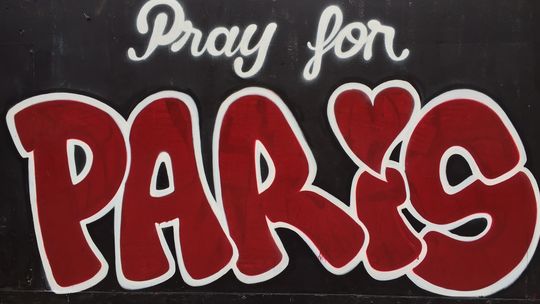
It’s been an interesting couple weeks, with Islam dominating the news. The horrific attacks in Paris stirred up a tremendous amount of sympathy, fear, and not always constructive reactions around the world. France’s president promised a “ruthless” response, and subsequent raids across France and bombings in the Middle East were evidence of his sincerity.

Meanwhile, many cities and nations questioned the wisdom of welcoming Muslim refugees inside their borders, turning them away to go…where exactly??

An altogether different response arrived in my email inbox this week—an Islamophobic letter warning me that “We Now Have a Muslim Government,” citing erroneously that leaders such as John Brennan, head of the CIA, and presidential advisor Valerie Jarrett were Muslims. The letter also falsely claimed President Obama is a “closet Muslim” and sounded this gloomy assessment of our future:

Obama and his minions are systematically destroying our nation, supporting radical Muslim groups worldwide, opening our southern border, and turning a blind eye to the genocide being perpetrated on Christians all over Africa and the Middle East. The more damage Obama does, the more arrogant he’s become! Our nation and our government has been infiltrated by people who want to destroy us.

These wild accusations of a conspiracy theorist couldn’t be farther from the truth. If you receive any similar bogus emails, please tell the sender to check his facts and instead of spreading fear, try becoming part of the solution.

So…the world’s responses are ruthless revenge, heartless rejection, or delusional fear. Surely there is a better option for us?

Lately I’ve been working on editing my manuscript for the sequel to my first novel, SOMEONE HAS TO DIE, hopefully to be published in summer 2016. In my new book, I’ll address the issue of ISIS and what a more godly, effective, transformational response could look like.

But while you wait for your summer reading, a group of leading Muslims around the world have got a jump on me by authoring an open letter to the self-appointed “Caliph” or leader of ISIS, Al Baghdadi. This 28-page letter presents beautifully how far from orthodox Islam ISIS has strayed. I especially recommend you check out the page explaining jihad and the page on the treatment of Christians (“People of the Book”) if you want to discover how the leading Muslims of our world truly feel about these issues. You can read the letter and who signed it here: http://www.lettertobaghdadi.com/

The tragic loss of life in Paris should produce a righteous anger in our hearts. However, neither ruthless revenge nor finger-pointing fear will solve the problem or bring healing to our world. I’ve said this before and I’ll say it again: Islam is not our enemy. Hatred, prejudice, violence and fear are our enemies.

And since these are common enemies to all mankind, let us join together as humans to overcome those evils with good.

A Shining Day for America

bremertonmuslimsupportLike anyone, America has its good days and its bad days. October 10, 2015 was one of our good days.

Let me quote from one report about the anti-Muslim protests across our nation:

“Most of the planned protests simply didn’t happen after all. Among the few rallies that actually came together, the counter-protesters well outnumbered the anti-Muslim activists.”

In Michigan, Maryland, Tennessee, Alabama, Oklahoma, Oregon and Washington DC, hardly anyone showed up to protest, but concerned neighbors and churches were there anyway to show support.

Phoenix, AZ was the only place that actually felt like a protest, but though a lot of guns were seen, thank God it passed peacefully.

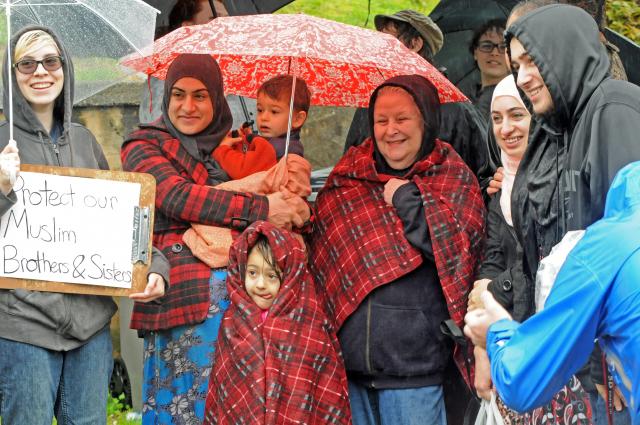
In heavy rain falling on Bremerton, WA, about 35 locals came, concerned for their Muslim neighbors (photo above). No protestors braved the storm. “We don’t mind getting wet,” one of them told Hatewatch. “It’s worth it to defend our friends.”

One of the best stories came from the Noor Islamic Cultural Center in Michigan, where one lone protestor showed up. A Caucasian man exited the mosque to start a conversation with her. She thought he was Muslim and responded with “Get behind me Satan!” The man told her he was actually Jewish, and after some dialogue got her talking with some of the Muslim women from the mosque who also affirmed how much they were against the violence and murder of ISIS-type groups. The story ends with the protestor coming into the mosque to join a special breakfast they had prepared for all the protestors! She thought she was taking a stand against the enemy and discovered new friends.

Meanwhile, many interfaith groups across the country planned events to show their support for the Muslim houses of worship, some including positive social action plans.

The Huffington Post concluded that the end result of the protests, in fact, was a large outpouring of love and interfaith support for the Muslim community.

Well done, America! Thank you for your prayers for peace this weekend. Thank you to those who showed up at a mosque. Way to turn hate away and show that #LoveYourNeighbor is still worth standing in the rain for!

#LoveYourNeighbor

A demonstrator holds a sign at a "Freedom of Speech Rally Round II" across the street from the Islamic Community Center in Phoenix, Arizona May 29, 2015.  Arizona police stepped up security near a mosque on Friday ahead of a planned anti-Islam demonstration featuring displays of cartoons of the Prophet Mohammad, weeks after a similar contest in Texas came under attack from two gunmen.  REUTERS/Nancy Wiechec
A demonstrator holds a sign at a “Freedom of Speech Rally Round II” across the street from the Islamic Community Center in Phoenix, Arizona May 29, 2015. Arizona police stepped up security near a mosque on Friday ahead of a planned anti-Islam demonstration featuring displays of cartoons of the Prophet Mohammad, weeks after a similar contest in Texas came under attack from two gunmen. REUTERS/Nancy Wiechec

In my last blog I let you know about the anti-Muslim protests planned for this weekend. In this update, I want to share with you what just one person is doing about it.

Catherine Orsborn is from Shoulder to Shoulder, a Peace Catalyst-related organization. Here’s a letter explaining how she is rallying people to respond:

Hi, all,

Thank you so much for all of you who have made connections with your local clergy in the lead-up to this weekend’s hate rallies targeting Muslims.  We’re sending the below email out to the Shoulder to Shoulder community lists tonight to mobilize a mass social media move against the hate rallies this weekend.  It’s been complicated trying to organize local communities on this because most of the Islamic Centers we have connected with do not want any extra media attention brought to these protests, and therefore are asking us to refrain from counter-events- we got coverage in the Huffington Post on this point.  However, we need to be out in public showing our opposition to this hate, so have been working with some other national groups on social media strategy.  It’s included in the note below.

Our asks for you: Will you 1) use your denominational or organizational owned social media to participate in this social media campaign starting this Friday at 3 pm (not before, please, to concentrate the timing with our national partners!), 2) send this note out to your communities as you’re able, and 3) have your head of denomination or other high profile clergy participate in a tweet, and send it to us (@S2SCampaign or Catherine.Orsborn@s2scampaign.org) so we can highlight many religious leaders speaking out at this critical time.

Thank you!

In solidarity,

Catherine

This weekend:  #LoveYourNeighbor #HateUnchecked

Many of you have heard by now that there are a number of anti-Muslim events planned to take place around the country on October 10 (this Saturday).  Our partners at the Center for New Community are tracking these on this site and have an interactive map where you can see the locations, with links to the Facebook pages, for the events.  These are demonstrations of hate that go against the values of our religious traditions to love and extend hospitality to our neighbors, and against the highest ideals of our nation.

We know that there are Shoulder to Shoulder partners, along with concerned clergy, communities and individuals, around the country who have been actively fighting against anti-Muslim bigotry in their communities and building long-term relationships with their Muslim neighbors for a long time.  Public demonstrations of hate targeting the Muslim community are the reason Shoulder to Shoulder exists as a network of religious and interfaith individuals and groups.  This is a time when the Muslim community needs to hear and see our support.  Our national leaders are speaking out against this, as are many local clergy.

If you have not already, we encourage you to check on this map to see if there’s an event planned near you, and reach out to your Muslim friends and neighbors, and to interfaith networks that are in conversation with the local Muslim community.  Offer to help or to stand with them in solidarity, and ask them what they would like their friends from other religious communities to be doing right now to show support for American Muslims.

Many local Muslim groups have asked that people not turn out in large groups to the protests in order to avoid giving these groups more media attention than they have already gotten.  Other local groups may want interfaith allies to show their support through turning out people to surround the Islamic Centers (or perhaps another Islamic Center nearby) in a ring of solidarity.  Regardless, our nation and the world needs to know that this type of anti-Muslim hate doesn’t go unchallenged by our faith communities.  Whether or not your local Islamic Center wants a physical display of support from their interfaith partners this weekend, and even if you live in a location with no protests, we are encouraging everyone to participate in a social media pushback against this hate.

Join us starting this Friday at 3 pm EST (please wait until then to maximize social media takeover potential) on Twitter and Facebook to begin the nationwide social media pushback against these hateful acts.  We are using the hashtags #LoveYourNeighbor and #HateUnchecked, and we encourage you to post photos, videos or other sharable content with these.  Here’s a Facebook event page concentrated on the #HateUnchecked piece of this campaign, and as an inter-religious organization, we have added #LoveYourNeighbor.  Some ideas for social media engagement:

  • Post a photo that shows positive interactions between Muslims and non-Muslims in your community (from a dinner, a service project, or just hanging out), tagged with #LoveYourNeighbor #HateUnchecked
  • Post a quote from your religious tradition (scripture, a quote from a religious leader, etc) tagged with #LoveYourNeighbor #HateUnchecked
  • Post a video of yourself or with others stating what in your religious tradition drives you to stand against this hate, tagged with #LoveYourNeighbor #HateUnchecked
  • Post a photo of yourself (in clerical clothing, if that applies to you) – alone or with others in your community- holding the attached sign and tag with #LoveYourNeighbor #HateUnchecked
  • Some sample tweets:

o   Silence from the majority will destroy our country.  We can no longer sit back.  We must all raise our voices against #HateUnchecked.  #LoveYourNeighbor

o   My religious tradition teaches us to #LoveYourNeighbor.  We won’t sit silently when there is #HateUnchecked.

o   Our country is at its best when all communities are treated with equal dignity and respect #LoveYourNeighbor #HateUnchecked

o   “Do unto others” means religious freedom for all #LoveYourNeighbor #HateUnchecked

If you want to get together with others this weekend, you might consider hosting a public watch party of Unity Production Foundation’s new short film, “American Muslims: Facts vs Fiction” or one of their many other excellent productions on Islam, and hold a conversation about the issue of anti-Muslim bigotry in America.

There are many ways to engage and stand up with your Muslim neighbors this weekend.  Please tweet at us @S2SCampaign and let us know what your community does to come together in support of American Muslims this weekend!

In Solidarity,

Catherine

Personally, I love Catherine’s creative response! If you’d like to see another one, I’ll leave you with a link to a very different kind of response, but equally beautiful, that was successfully tried before (the photo beginning this article comes from this event):  http://tempe.redemptionaz.com/resources/blog-posts/detail/a-bright-night-for-the-church-a-recap-of-the-phoenix-mosque-protest/

Thank you for caring enough to take time to look at these links. Our country is not under attack by Islam. It is under attack by hate and prejudice. These can be found in people claiming any religious faith.

Is our love big enough to take this challenge? #LoveYourNeighbor

Love Excludes Prejudice

mosque protest


There are anti-Islam protests—some armed—planned across America this Sunday, October 10th. Please take a moment to read about it here: http://imagine2050.newcomm.org/2015/09/29/anti-muslim-protests-some-armed-planned-for-at-least-20-sites-across-the-country/

How does that article make you feel? Is it possible to be a patriot and yet love your neighbor too?

This Sunday my wife and I enjoyed a wonderful church service in Indonesia, specifically for the poor, the prostitutes, and the mentally insane. About 60 people, or half the congregation, came from this last group. These were women who used to wander the streets naked, or were rejected by their families because they had become unable to function in the world. Some of them still don’t speak at all. But they were welcome at this special church service for them.

I noticed the worship band was made up of good-looking, smartly dressed young people who were there to serve others. As they sang, everyone was invited to dance to the music, which many of the crazy people seemed to really enjoy. Those able to speak were invited to take the stage and share how God had answered their prayers. It was a beautiful, joyful moment in the week when everyone’s individual problems could be put aside to belong to God’s family together.

The next morning I was reading the Passion translation of the Bible, and came across this heading to James chapter 2: The Royal Law of Love Excludes Prejudice. Verses 8-9 instruct us: Your calling is to fulfill the royal law of love as given to us in this Scripture: “You must love and value your neighbor as you love and value yourself!” For keeping this law is the noble way to live. But when you show prejudice you commit sin and you violate this royal law of love!

Here James is quoting both Moses and Jesus. He reminds us that following Jesus doesn’t mean there is no law—the Law of Love has become our “noble way to live.”

This love excludes all forms of prejudice. Whether it’s telling a black person to sit in the back of the bus, or giving a woman lower wages than a man for the same job, or refusing to sell your wedding cakes to a homosexual, or protesting the building of a mosque/church/any other house of worship in your community, or talking about any group of people with negative stereotypes—there is no room in the Royal Law of Love for any kind of prejudice.

The offering this church took from the poor and crazy I doubt would cover the cost of electricity for their sound system or their bread and juice for communion. Did they really need a full worship band with five vocalists and two dancers? After all, half the congregation might go home and immediately forget everything that happened. This church gave their best for the poor just as they probably had given in an earlier service that morning for the rich.

So I ask the American Christians reading this blog—is protesting at Islamic Centers across the nation the best we can give our Muslim neighbors? If not, what could we give them that shows our love? I’m talking about showing the same kind of love if those were our church members being victimized by hate? If that protest was outside our church, instead of our neighbor’s house of worship, what would we do?

One of the great challenges of being a peacemaker is loving all sides of an issue—loving the victimized Muslim neighbor, and loving the protesters shouting their hate at the same time. For those of you living in one of the targeted cities, I encourage you to ask God for your own creative way to fight prejudice with the Royal Law of Love.

“For keeping this law is the noble way to live.”

Book Review–THE SEVEN MOUNTAIN RENAISSANCE by Johnny Enlow

7 Mountain RenaissanceI’ve been a fan of Johnny Enlow’s books for some time, but this one more than any book I’ve read in the past few years put into words many of my feelings on what’s wrong with Western Christianity, and more importantly, what’s right, with a tremendous hope for the glorious expression of our faith that is coming.

Johnny explores what God is doing and is about to do in each of the seven “mountains” or primary spheres of society: religion, education, family, government, economy, media and celebration/arts. With an insightful understanding of history and a true prophetic vision of what’s on God’s heart for this hour, he paints a panorama of beauty, restoration and glory that the Bride (church) of Christ will become by 2050.

Johnny also instructs those on each mountain in what we can do to get there. As an educator, I was excited to read his concepts, aligning so closely with changes in education that I’ve been feeling needed to happen. His chapter on the economy talks about new models of business that integrate properly with the other spheres of life to become blessing to all of them rather than dominate or steal from them. The school where I teach for years has been operating under a completely different model of success than the world’s, but this was the first time I read about it in terms of God’s heart to make business glorious.

Another strength of this book is how Johnny unpacks some of the controversial issues of today. I’ve rarely found American Christian writers I can fully agree with on some of today’s tough issues such as abortion, homosexual marriage, women’s rights, immigration, racism, prison reform, and relating to those of non-Christian religions, but Johnny eloquently and prophetically expresses perspectives on these issues that reject the rule of fear and truly reflect God’s love, with fresh ideas for followers of Jesus on how to reengage these spheres with that love and immense hope for His goodness to breakthrough. When we tackle any of these issues motivated by fear, we can fall into dehumanization, building walls, and trying to isolate ourselves from the very people God wants to put His arms around and embrace.

We choose to align ourselves either with a fear-filled worldly cynicism or a hopeful, loving pursuit of God’s Kingdom (His better ways of doing things) coming “on earth as it is in heaven” by how we pray; what we choose to post, tweet or Instagram; what different kinds of people we’re willing to make friends with; and how we choose to invest in building a culture of love, light and life all around us. Johnny writes, “No matter what your race, culture or nationality, God is restoring the destiny of your city and your nation.” Each one of us has a part in this global renaissance.

Here’s one of the book’s many predictions: “An on-fire, loving church that has a hopeful perspective on life will be globally advancing by 2050.” This advancement is not about domination or Christians “taking over”—it’s about the pure release of God’s compassion, hope, and wisdom for practical problem-solving that makes every sphere of society a better place. For those who are tired of listening to the doom and gloom Christian talk-show hosts, let this book lift your eyes to perceive this as the greatest time in history, when the “earth will be filled with the knowledge of the glory of the Lord, as the waters cover the sea.” (Habakkuk 2:14)

Find out more at www.johnnyandelizabeth.com.

Buy from Amazon: The Seven Mountain Renaissance: Vision and Strategy through 2050.

Where will my journey end?

   I read a fascinating story recently about a man named Ed. Ed’s parents were religious, but felt that faith should be confined to yourself and your immediate faith community. In high school, Ed met some teenagers who were on fire for their faith and concerned about its global advancement. He joined their youth group and soon was on fire for his faith too.

Then Ed met a group that was even more radical, and he joined them. These guys were bold enough to stand up in public places and preach, challenge atheists to debates, and organize events to protest the government’s ungodly actions. Ed became a leader in this group, and started cell groups in several universities. He loved their organized approach to how they systematically targeted groups of people with their message, discipled them in their core beliefs, and believed their message would one day change the whole world.

Ed considered himself a “born-again” follower of the truth, one of the real disciples of the faith. But then a series of events exposed chinks in his spiritual armor.

First, he noticed that he and his leaders were so busy mobilizing, recruiting and preaching that they rarely had time to pray. He began to wonder which God wanted more—all the world to hear this message, or his heart?

Second, he met a girl. She shared his faith, but not his intensity. He realized that while he was always serious, she was happy. Not only that, she was kind and compassionate to others. She asked him how his radicalness could be good if it drove a wedge between him and his parents?

The last straw came when an argument broke out between someone from his cell group and a college student from another religion. The argument turned into a fight, and the other guy was killed.

Ed realized he had often preached on the superiority of his religion and God’s hatred against those that rejected it. He had never imagined his message could be interpreted that it was okay to kill another human being.

Ed left the radical group and began an intensely personal pursuit of God for his own heart. Along the way he met other charismatic leaders who spoke of God’s love for him and for the whole world. Ed realized that he had lived a life of religious fervor, but not one born out of love.

As his heart changed, he began to find himself able to love and accept those from different backgrounds and religions, and Ed became a peacemaker.

Reading this story reminded me in ways of my own spiritual journey, as well as many of my friends. We grew up in Christian homes. Ed grew up in a Muslim home. Yet our paths have remarkable similarities.

In any religion, there is a danger of being so consumed with our religion’s progress and advancement that we lose touch with God’s wooing of our hearts. Jesus put it this way: “And what do you benefit if you gain the whole world but lose your own soul?” (Matthew 16:26 New Living Translation)

I also love the litmus test for true spirituality the Bible gives us in I Corinthians 13:1-3 (the Message translation):

If I speak with human eloquence and angelic ecstasy but don’t love, I’m nothing but the creaking of a rusty gate.

If I speak God’s Word with power, revealing all his mysteries and making everything plain as day, and if I have faith that says to a mountain, “Jump,” and it jumps, but I don’t love, I’m nothing.

3-7 If I give everything I own to the poor and even go to the stake to be burned as a martyr, but I don’t love, I’ve gotten nowhere. So, no matter what I say, what I believe, and what I do, I’m bankrupt without love.

In every human heart, no matter what ethnic, religious, or social background people come from, there is a longing to be loved and to love. God created that longing in us, because it’s how He wants to relate to us. As Jesus’ disciple John wrote, “The person who refuses to love doesn’t know the first thing about God, because God is love—so you can’t know him if you don’t love.” (I John 4:8 the Message translation)

I recommend Ed Husain’s book The Islamist (http://www.amazon.com/The-Islamist-Became-Islamic-Fundamentalist/dp/0143115987 ) to all my Christian friends, to help you understand some of the different faces of Islam, how ordinary people get caught up in the radical groups, and how many also find a way out. I recommend it to my Muslim friends for the same reason.

And for all my friends, I bless you on your spiritual journeys to encounter the God of love who is wooing your heart today.