Christians & Muslims work together in Afghanistan?

You all know about my work bringing Christians and Muslims together in Indonesia–in fact, this week members of both groups are coming together for prayer and fasting for personal breakthroughs, and expecting God to surprise us with His miracles, reminding us how extravagant His love is for us!

But in Afghanistan?? Yes, believe it or not, God is breaking down walls even there, as my good friend Thomas Davis of Peace Catalyst writes below. (And if you want to hear more from Thomas, I encourage you to visit his website Incomparable Treasures). Take it away, Thomas…

Stories from Afghanistan: A Journey of Faith and Friendship

Earlier this year, I had the privilege of visiting Kabul, Afghanistan as a guest of a Muslim non-profit focused on education projects. I was inspired and encouraged by both my new Muslim friends there and by the way I experienced God in Afghanistan!

In the coming weeks, I intend to unload some of my stories and impressions here on Incomparable Treasure. The order promises to be random in a stream-of-consciousness sort of way, and it is my hope that as I put fingers to keyboard that my “Stories from Afghanistan” series will offer you a window into the hopes and dreams of the people who live and serve there and ultimately into the broader story of God and His vast, relentless love for all people.

To get started, I will offer you a bit of background and foundation for the stories that will follow.

The Backdrop: A Journey of Faith and Friendship

For me, this recent visit to Afghanistan was the latest high point in an amazing, life-changing, three-year journey of faith and friendship. It began with an assignment in New Delhi as Interim Director of an English language institute. In that context, I met a young Afghan man—a Muslim who quickly became like a brother to this evangelical, Bible-believing Jesus-follower from America. As our friendship grew, we each invited the other deeper into our respective worlds. I introduced him to my Peace Catalyst colleagues and our Jesus-centered work, and he invited me ever deeper into his global Muslim network known as the Gülen Movement (www.gulenmovement.us).

My smart, feisty, compassionate Afghan friend and I have laughed together and cried together. We have studied the holy books with one another and have spent countless hours talking about God and His Kingdom and how one lives in right relationship with Him and others. We also dreamed often about working together for the common good, acknowledging that both Christians and Muslims have too often embraced peace-breaking attitudes and actions. My friend and I surmised that we need each other, because I can challenge Christians in ways that he could not and likewise he can admonish Muslims in ways that I could not.

The Invitation: Muslims Invite an Evangelical to Serve

Against this backdrop, my friend persuaded the leadership of the Afghan-Turk Educational NGO to bring me to Kabul to offer a 15-day language seminar for their teachers and to see their work up close so that we could explore more and bigger partnership for the future. The invitation came in late November. A month later, I was en route to Kabul on a journey fully funded by generous-spirited Muslims who invited me to serve alongside them, apparently undeterred by my passion for Jesus and his ways, words, works, and worth.

The Context: The Afghan-Turk Educational NGO

My generous hosts in Kabul comprise the Afghan-Turk Educational Non-Government Organization (NGO), a Muslim non-profit based out of Turkey. The NGO is an affiliate of the Gülen Movement, an international network of Muslims working in 180 countries with a focus on practical service to the less fortunate and on building bridges of friendship between Muslims, Christians, and others.

In Afghanistan, the NGO runs over 30 schools across the country, offering over 5000 Afghan children rare access to high quality education with solid emphasis on the foundational values of human rights, human dignity, and respect for all people. I was seriously honored to serve alongside these kind-hearted educators, many of whom are foreigners (mostly Turks but also Indians and Egyptians) making significant sacrifice to serve in a challenging environment.

Next in the Stories from Afghanistan Series—When God Ran

Both God and my Afghan and Turkish hosts gave me some encouraging and sometimes surprising gifts during my journey. In the coming weeks, I want to share some of those gifts with you—stories about

  • the strength of diversity as the love of children overcomes the hatred of adults
  • the sacrificial love of Turks and Afghans in the face of enormous risk
  • bald heads and snowball fights
  • jihadists and communists laying down their arms and ideologies
  • friendship, honor, and fake airplane tickets
  • finding common ground and discussing differences in the context of real friendship.

One major gift was the spiritual conversations along the way with new Muslim friends. In the next “Stories from Afghanistan” post, I will share the story of “When God Ran: Jesus, the Prodigal Son, and Unexpected Common Ground in a Kabul Classroom!

Subscribe to Incomparable Treasure!

To make sure you do not miss new posts on Incomparable Treasure, sign up to receive email notifications. On the right side of this screen and above the Davis family photo, find “FOLLOW BY EMAIL,” enter your email address, and hit “submit.” This will ensure that you will receive an email each day that a new story is posted.

The Importance of Reconciliation in Conflict Resolution – Part 2

Apartheid wall - Palestinian West Bank
Apartheid wall – Palestinian West Bank (Photo credit: nagillum)

I’m a bit behind on my writing due to moving from the US back to Indonesia, back to our work with local Muslims and Christians pursuing peace.  What a joy to be surrounded by people here who share a common dream for a better world and are willing to put aside their personal prejudices and pain to fulfill that dream!

Having a common dream positions us on the same side of any conflict—no longer US vs. THEM, but PEACEMAKERS vs. HATE, PREJUDICE, OPPRESSION, etc.  Whether we’re praying as a mixed group in our House of Prayer, or praying alone at home, we are learning to pray as one unified group.  It is my hope that this will lead to also identifying not only with the victims, but also with the victimizers, and praying as though they belong in our group as well: “Forgive US for our hatred and violence, heal US of our traumas and judgments toward others, show US ALL the best way forward to peace.”

Pastor Bill Johnson of Bethel Church in Redding, CA teaches that true intercession isn’t praying for God’s mercy for “them,” but identifying with others so deeply that we see ourselves in the same group together, crying out for mercy for “us”—an “us” that includes both ourselves and them.

It is this mindset of breaking down the walls between groups that separate us, and learning to identify with others as though they all were a part of “us,” that is needed when the reconciliation process begins.

Reconciliation begins when one person walks through the separating wall towards the offender (or one representing an offending group), hears their story and seeks to understand and feel their pain, and identifies himself as one of the same group (eg. a fellow-human, a fellow-sufferer, a fellow-seeker of God, a fellow-pursuer of peace,  etc.).  If the other person can receive this repositioning, both will find themselves companions on the same side of the wall.

The first time this happens for some people, it is mind-blowing.  Many Christians have never imagined a Muslim could be on the same side as them about anything; the same is true of Muslims never imagining Christians could be on their side.  But when that magical moment happens, suddenly a massive group of perceived enemies becomes an unlimited source of potential friends.  People previously observed and quickly passed over because of their clothes or other outward sign of “otherness” are examined more closely, as though one is singing a melody blindfolded while listening for who might be humming a harmony unnoticed before.

The exchange of ideas, truths and beliefs only flows freely between those on the same side of the wall.  We all know how easily we can hear new ideas from those who are similar to us, and how resistant we are to ideas from those who come from groups we don’t like.  Many people do Christian evangelism or Muslim dak’wa by lobbing “truth grenades” over the wall to destroy the arguments of the other group.  A sincere hearing of each others’ differing beliefs can only happen when we find enough in common that we are willing to hear difficult words from a friend, with complete assurance that we’ll remain friends who will always carry some level of difference in our personal, cultural and religious beliefs.

Those differences do not threaten our relationship—they enrich it.  Those differences deserve to be treated with honor.  At the same time, people do change, and love is the most conducive of all environments to incubate radical change.  When we’re positioned on the same side of the wall, we both will change.  This combination of the love which brings us closer to one another, and the honor we show for our differences, testifies to the world of hope for reconciliation, conflict resolution, and true peacemaking.

The Importance of Reconciliation in Conflict Resolution

Handshake icon

Effective peacemaking depends on Conflict Resolution–but Conflict Resolution without Reconciliation is rarely effective.

This December I’ll be writing a 2-part blog on this topic.  Part 1 is already written and posted on the website of my good friend and amazing peacemaker, Thomas Davis (who will also soon be a guest blogger on this site!).  Please read it by going to Thomas Davis’s blog link below right, or typing in this link: http://www.incomparabletreasure.com/

After you read Part 1 on Thomas’s blog, watch for Part 2 coming on mine soon!

Jim’s Top 3 Books of the Year

All 3 of the following books touched me deeply, changed my paradigms, and brought revelatory freshness to my calling as a peacemaker.

    Tattoos on the Heart: The Power of Boundless Compassion  by Gregory Boyle is my favorite book of the year! It ripped me up. I cried every time I opened it–in the restaurant, in the airport, on the airplane–everywhere!

Greg is a Catholic priest who has given his life to serve the gang members of my own city of Los Angeles. His way of loving every single person, and seeing the beauty and nobility in them even when they’re at their worst, so reminds me of God’s love for us.

One quote from the book I’ve been meditating on and trying to live out in all my relationships is: “Here is what we seek: a compassion that can stand in awe at what the poor have to carry rather than stand in judgment at how they carry it.” (p.67)

    Speaking of Jesus: The Art of Not-Evangelism  by Carl Medearis is another book I loved this year, a book that sets religion aside to focus on living, loving and speaking like Jesus. Carl is a pastor who prepares his Sunday sermon notes while sipping coffee in a gay bar because he believes Jesus would more likely be found there than in a church office.

Some of Carl’s best friends are politicians, homosexuals, or Muslims. Sounds to me a bit like Jesus’ friends, the “tax collectors, prostitutes and Samaritans”–or we could say, people who abuse their power, people who are risky to be seen with, and people from a “rival” religion. But when Carl talks about Jesus to these people, they listen, maybe because Carl IS like Jesus.

    Culture of Honor: Sustaining a Supernatural Environment  by Danny Silk is a third book that really challenged my relationships with others (see my earlier blog on “Intimacy”). Danny’s premise is that successful communication is not about persuasion, but understanding; and someone who fails doesn’t need my punishment or control to fix them, they need my forgiveness, continued trust and freedom. A love that is not afraid of sin brings out the best in people.
All 3 of these books are saying essentially the same thing. We’ve built walls to protect ourselves or others from getting hurt: walls of geographical or emotional distance, walls of stereotypes and judgments, walls of punishment and control, and many others. The way of Jesus, and the true way forward for us, is to move TOWARD the other–the offender, the one who is different, the one we’re afraid of–and find in us a love bigger than our fears.

Any individual or group that we find it hard to love, Jesus offers us grace to see the awesomeness in them that He sees, and courage to take a step towards them in love.

Anyone else read these books and would like to comment on them?? Write me!

Healing the Wounds of 9/11

In 2003, President George W. Bush sent American troops to invade Iraq.

We were living in Indonesia, and many Muslim students opposed the war. Just 50 yards from our office (the only business in town where Americans worked), protestors hung banners stating, “Go to Hell America,” and “George Bush is the great Satan.” We wondered if the demonstration would migrate to our building, and discussed what we should do.

If you were in my shoes, which of these options might YOU choose?

a) tear down those banners and publically defend the good name of my country

b) stay home from work, and if anyone knocks, answer them in a Russian accent

c) be myself, and proactively look for positive ways to build friendships, even with those who judge me based solely on my nationality

I chose letter “c.” I didn’t defend the decisions of American politicians, nor feel ashamed to be an American. In fact, I told my Muslim friends that I had prayed against the invasion, and now would pray for all those on both sides who would suffer because of it. I assured them that I was an American who loved Muslims and loved peace. And I looked for more ways to actively promote peace.

Not long after that, our Peace Generation educational initiative was launched, with Muslims and Christians working together to train the younger generation in how to develop peaceful, mutually supportive, loving relationships with those who are different than you. Our PeaceGen went on to train thousands of youth and win a national award for peacemaking.

In the face of hatred, stereotyping, prejudice, and even potential threats, I chose to move TOWARD those whose hurt and anger had blinded their eyes from seeing me clearly—as I got closer to them, their eyesight cleared, and we became friends.

In 2001, another American went through a similar situation. As a 16-year-old girl, Hanadi watched from her high school classroom window when the second plane crashed into the World Trade Center. Immediately aware of the potential danger, the staff began to evacuate the students from this K-12 New York City school.

But Hanadi was still in the school yard shepherding small children when people began throwing glass bottles and pieces of pork at the students—simply because it was a Muslim school.

In the days that followed, Hanadi and her classmates, many of them born and raised in America and no less Americans than I am, were harassed, bullied, and belittled frequently. These kids had never met a terrorist, but were treated as though 9/11 was somehow their fault.

This unconscionable behavior could have driven Hanadi to defend her religion with vengeful, violent means. It could have driven her to hide in her home, or only go out in public without her headscarf to avoid persecution.

Instead, Hanadi chose like I chose, to be herself, and to proactively look for positive ways to build friendships, even with those who judged her solely on her religious affiliation. She decided to move TOWARDS those whose eyes were clouded with pain and anger. She joined Park 51.

About 3 blocks from the tragedy of Ground Zero, a small seed of hope is sprouting—a community center, founded by Muslims who abhor terrorism and love peace, seeking to rebuild the community upon the values all Americans cherish: freedom to be yourself, while uniting with others from many backgrounds to make our community and our nation a better place. It’s a place for Muslims to come and pray and to hear sermons that promote peace and unity. It’s a place for non-Muslims to come and share and be welcomed in as friends. And it’s a place for all kinds of community classes or gatherings, many of which have nothing to do with Islam, and everything to do with enriching the lives of the whole community.

The victims of the WTC tragedy weren’t just those who died in the building—they were also thousands of American Muslims around the country who were unjustly persecuted. Many lost businesses or jobs, lost friends, were threatened, beaten, treated as exiles in the very communities they had loved and served.

Some people (even Christian leaders) have overlooked this stain on the American conscience, choosing to focus only on the fall of the towers. They think that those victims of the 9/11 attacks are better honored by distancing ourselves from all Muslims. I say that the only way to move forward in healing is to find those people (Muslim, Christian, anyone) who are committed to peace and rebuild our hurting community together. I’m blessed to see Hanadi leading the way—who will join her?

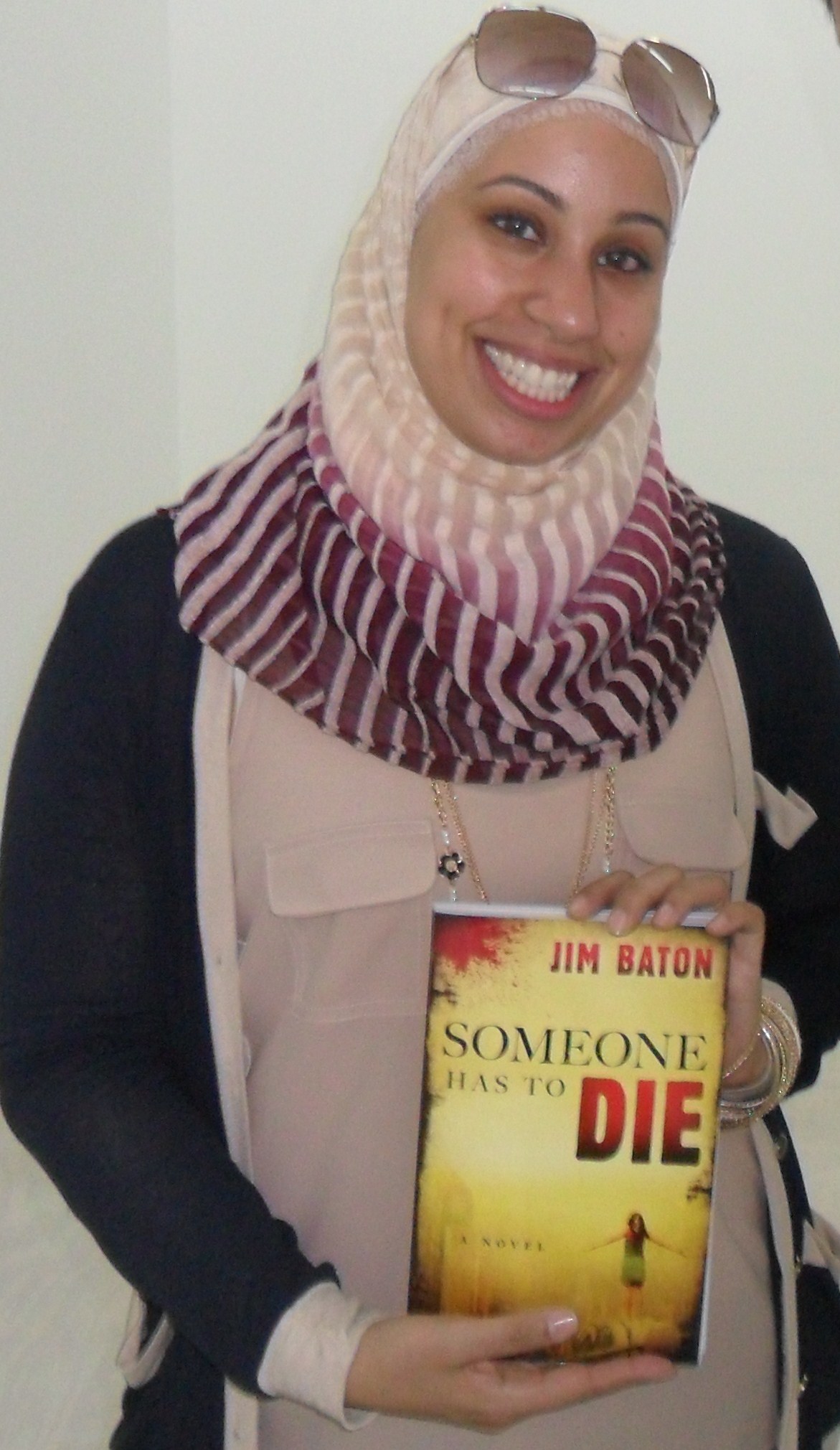
Sometimes a broken place in us, when healed, can grow even stronger than it was originally. This is my hope for New York City. It was an honor for me to present a copy of my book to Park 51, and to pray for God’s blessing upon their beautiful vision for peacemaking.

My Response to SOMEONE HAS TO DIE — by “Grace”

Flag used by Caucasian jihadists in 2002. The ...

JIM’S BOOK BROUGHT HEALING TO MY HEART OVER MEMORIES OF MY CHILDHOOD IN THE MIDDLE EAST

When I read “Someone Has to Die,” I couldn’t put it down. I read it till about 4:30 in the morning till I finished. It was well-written, fast-paced, action-packed, emotionally rich, and relationally challenging. It reminded me of some wild experiences I had as a child growing up in the Middle East. The best part was the LOVE displayed by characters in the book, both Muslim and Christian–that was phenomenal. It is that kind of love that brings a sense of peace to the most chaotic circumstances.

The story was beautiful and moving; but beyond that, there was, for me, a stirring in my spirit. The story churned up my own story; and I needed resolution. So first thing when I woke up I went to one of my favorite places to pray. When I was eleven years old my family moved to a war-torn Islamic country. I thought of it as a grand adventure and an adrenaline rush, even in some very scary times. As an adult I have been gradually realizing that many of my childhood ways of thinking and feeling weren’t based in reality. We were in genuine danger sometimes. And there were probably more feelings I should have been having than just, “Oh, how exciting.” So when I went to pray the morning after I finished the book, I asked God what feelings he had about those events.

I remembered one time I was riding the bus with my mom, my siblings and some other expatriates. These wild, armed men kept trying to steal a ride, (or maybe rob us), and a guy at the door would bribe them to go away. Finally, the driver got so mad because the bribe money had run out so the next time some of these thugs tried to flag us down, he just kept driving. Then it was their turn to get mad, and they shot out the side view mirror. The driver stopped then; and a bunch of wild-haired men came pouring onto the bus. One motioned for my brother to move over close to me and sat down in the aisle seat. Others found places on the stairs. We rode maybe 3 or 4 hours like that. At one point, a boy came on the bus with a basket of pomegranates and the hitchhikers stole some from him. He ran off yelling and throwing rocks back toward the bus. Typical of Middle Eastern hospitality, the thieves then offered us some! We said no. My brother and I, wide-eyed in amazement at this new home of ours, thought of it as a grand adventure, as usual.

So when I went to pray the morning after reading “Someone Has to Die,” I remembered this story, and I started to feel the compassion of Jesus towards these men. I started saying, “Isa Masih! Rahman o Rahim!” over and over again. Mostly when starting a journey or anything of significance, Muslim people say, “Bismillah Rahman o Rahim” –it means, “In the name of Allah, the Compassionate, the Merciful.” I felt the compassion of Christ, so I was saying, “Jesus Christ, the Compassionate, the Merciful!” I always KNEW we should love our enemies, but I FELT it in a new way.  I had never really thought of those men on the bus as enemies anyways; they were just characters in my fantastic adventure story. Suddenly they were not just characters anymore; but people that Jesus feels great compassion for and on whom he longs to have mercy. Then I remembered the verse where Jesus says,  “He who receives you receives me, and he who receives me receives the one who sent me….And if anyone gives even a cup of cold water to one of these little ones because he is my disciple, I tell you the truth, he will certainly not lose his reward.” (Matthew 10:40-41, NIV) And again, suddenly, I saw our journey in this war-torn country with its deep and pervasive hospitality in a new light. Could Jesus be showing His compassion and mercy by allowing people to show hospitality to us, even as children with very little understanding—to receive us—even to offer us stolen pomegranates? Could that have been a sign of his mercy even to these men?

So then, I asked God to give me compassion for some extremist Muslim men who killed the father of a very close friend. They killed him for no reason, when he was working for the good of other Muslim people. I feel God’s desire for these terrorists. His sorrow over the darkness they carry. His anger over the lies they believe that keep them in chains, bound to a lifestyle of violence and hatred. He wants them; He wants them for Himself, to set them free, and to give them peace instead of war, compassion instead of hatred, life instead of death. That’s God’s wish and hope for those men.

Jim Baton’s book tells a story—a story of people who love and of people who hate; a story of children caught in conflict; a story of what happens to people who don’t understand the love of God and those who do. By itself this book is an interesting, stimulating, thought-provoking read. But I believe that when a reader is open to dialogue with the Spirit of God about this, then the true value of what Jim has written comes to light. It is a tool in the hands of God himself–a tool I believe He will use to bring peace and reconciliation, justice and compassion, understanding and mercy, friendship and love.

—“Grace”

How did God speak to your heart when reading SOMEONE HAS TO DIE?  Write in and let others know!

Ishmael–God Hears

An illustration of Genesis 21:18. Print 448 in...

This week I read a wonderful book by an insightful Pakistani brother, Faisal Malick, entitled HERE COMES ISHMAEL: The Kairos Moment for the Muslim People.  What I loved about the book was the tremendous hope Malick holds, based on the Bible, for millions of Muslims to find a fulfillment of their cry for God through the Messiah, Jesus.

Only 4 Bible characters were directly named by God: Jesus, John the Baptist, Isaac and Ishmael.  Ishmael’s name means “God hears.” In Genesis 21, as a teenager, Ishmael faces a faith-crisis like few of us could imagine.  First his own father rejects him and sends him away.  Then the supplies run out and he knows he’s going to die.  His own mother can’t bear to watch and distances herself from him, too, leaving him totally alone.  Malick imagines Ishmael may have asked questions such as, “Who am I?  The son of a patriarch, or just the son of a servant?” “My father taught me about God, but like my father and mother, has God forsaken me too?”  Even without the lack of nourishment, Ishmael could have given up on life with a broken heart, broken identity, and broken faith.

But in Genesis 21:17 it says that God heard Ishmael’s cry.  The prophecy hidden in his name became his experience.  And God opened their eyes to see a water source that had been with them all along but they just couldn’t see it.

Many modern Muslims express a similar heart-cry for God, but issues of rejection, broken hearts, fractured identities, and despairing faith have blinded them to the Living Water right under their noses–the Messiah, Jesus, highly honored in the Qur’an, coming again to Judge the earth, the one Healer who can bring wholeness to their hearts.  He’s already present to save for those with eyes to see.

Malick exhorts us: “We must intercede for the Muslims like a mother would for her dying child.  Some of us have walked away from Ishmael, just like his own mother did, because the condition of Ishmael seems so hopeless in many ways; but we must yield to the Spirit of God and [believe] God will hear the cry of the Muslim people in this hour.”

I believe that the truth of God’s destiny over the sons of Ishmael is not fully found in “Islam” which means “submission.”  The submission of a servant is not the same as the affectionate relationship of a son.  But God will reveal to the Muslim world the truth of their destiny hidden in the name “Ishmael.”  God hears.  Even in the greatest crisis, at the lowest point, God has not abandoned them, He hears.

Without a father, a son’s identity and destiny cannot be fully fulfilled.  Jesus said he came to “reveal the Father.”  Who needs this revelation more than Ishmael’s children?  And as I’ve said before, Malachi 4:6 prophesies this revelation is on its way!

When Romans 10:19 talks about Israel being “provoked” to jealousy by the salvation of the Gentiles, could it be millions of Muslims reaching out to the Jews with a new love found in Jesus will finally provoke the Jews to consider that Jesus could be their Messiah?  Wouldn’t that just be like Father God to use a good (but despised) Samaritan to bring healing to a hurting Jew, to use a long-lost son (unwanted by his own brother) who comes home to start a party in Father’s house for everyone, including the older son who never understood his Father’s love?

Pray with me for Muslims worldwide to see what they couldn’t see before–an open door (John 10:9) for them to come as sons back into the Father’s house.  And when it happens, I want to be in the house partying with them! 🙂

God’s Father-heart for Muslims

Abraham Sends Hagar and Ishmael Away (Gen. 21:...
Abraham Sends Hagar and Ishmael Away (Gen. 21:1-14) Русский: Авраам отпускает Агарь с Измаилом (Быт. 21:1-14) (Photo credit: Wikipedia)

I just returned from a speaking trip to Texas, where people asked me questions like, “Why do Muslims hate Christians so much?” and “How did we get into this mess anyway?”  I took those opportunities to direct them back to Abraham’s broken family relationships: the rejection, abandonment, jealousy, resentment, and broken father-figure that Ishmael inherited.

The question is, how can we minister healing to those heart wounds on an individual scale, then on a corporate scale, to Muslim communities and Muslim nations?

A vital key to our success in this is how we position ourselves.  Imagine Isaac coming to Ishmael with a superior attitude: “I got Daddy’s inheritance, but I’ll give you a handout now and again.”  Unfortunately, the Western church too often approaches Muslims with a superior attitude, and don’t understand when our isolated acts of kindness or generosity are looked at with suspicion or even rejected altogether.

We must position ourselves as equals, and invite Muslims to join us in the embrace of an Everlasting Father who does not reject or abandon us.  For many Christians, we need this revelation and healing for our own earthly father wounds before we can share it with our Muslim friends.  Only through their true Father’s acceptance can they find healing from their woundedness and rejection from their “earthly” father (Abraham), as well as the generations of fathers since.  We can open a new door for them back to the Father, and when they experience His love, they’ll be able to love those they couldn’t before.

I believe God is going to supernaturally help us in this process.  Malachi 4:6 prophesies that in the last days God will “turn the hearts of the fathers to their children, and the hearts of the children to their fathers.”  We already see this happening on a family level, with more dads than ever before realizing how important it is that they invest deeply in their children’s lives.  We also see a younger generation being taught about honor for their fathers in a fresh way.  Could God take this to a community and national scale?  How about healing the father-child wound (and resulting orphan spirit) within Islam?  In these last days, I believe we’ll see it happen.

I remember the day one of my Muslim friends got the revelation that God was her Father.  I never told her that, but the Holy Spirit whispered it to her, and it changed everything in her relationship with God.  May God pour out the revelation of His Father’s heart on all the sons of Ishmael!

Peacemaking that Produces Intimacy

English: Four hands holding.

I was listening to Danny Silk teach on communication in marriage today, and it struck me the implications for the peacemaking process.

Danny teaches that many of us have a wrong goal of intimacy, believing that it comes from getting the other person to agree with me.  We don’t value what we don’t believe or don’t understand.  So we try to convince the other person to join our values, so we can feel “one.”

The problem is that every person thinks and feels different things, and longs to be accepted and understood.  In a marriage, trying to convince our spouse to always agree with us makes them feel dehumanized.  They will probably rebel (creating outer conflict), or give in against their heart desire (creating inner conflict).  Both responses move away from intimacy.

So I thought about peacemaking….  How often do we approach the other with the goal of convincing them to agree with us?  If they have the same goal, neither of us learns to understand or accept the other and we move farther away from intimacy, strengthening the walls between us.

In marriage, Danny teaches that we need to be committed to understanding, valuing and expressing our own needs, thoughts and feelings, and understanding and valuing our spouse’s expressed needs, thoughts and feelings, creating a safe place to be real, accepting the other, and providing for the other’s needs.

What if we applied this to our relationships across religions?  What if our goals included sharing our needs and seeking how to provide for the others’ needs?

The difference is like going to a department store—have you ever gone shopping and met a salesman who tried aggressively to sell you something you weren’t looking for?  Did you look for the quickest exit, and avoid him the next time shopping there?  Much Christian “evangelism” comes across like this, with about the same result!  Compare that to the salesman who takes the time to understand what you’re looking for and gives you helpful input that may add something new to your original thoughts, but helps you get exactly what you wanted or something better.  What if interfaith dialogue worked like this?

Both my Christian and my Muslim friends want to be closer to God.  Most of them want to know Him more, feel His presence, receive answers to prayer about daily life issues, receive more revelation or wisdom, get their hurting bodies and hearts healed, have more victory over sin, bondages and addictions, and some even want to see God do miracles.  Many of them want to see God change the world and be a part of that change.

So I don’t meet Muslims at a theological debate table; I ask them if they would like to pray together with me for those issues we both understand and value.  In the process, we can feel with each other the longing for what we’re both missing in our pursuit of God; we can share with each other new ways for seeing those needs met; and we can find a place of intimacy where we treat each other as brothers.  The greater the intimacy, the greater the trust; the greater the trust, the more open we are to God using the other to change us.

Most Likely to Become a Peacemaker

Martin Luther King, 1964

Remember those high school yearbook predictions: most likely to become famous, most likely to become fabulously rich, etc.?  Have you ever thought about what kind of person is most likely to become a peacemaker?

In my novel, SOMEONE HAS TO DIE, you’ll be surprised at who is willing to take a risk for peace, and who does everything in their power to prevent peace.  You might think that a Christian pastor is more likely to pursue peace than a Muslim imam–actually, that hasn’t been my experience in the Muslim world, and you’ll get a taste of this harsh reality when you read the book!

True, Martin Luther King Jr. was a Christian pastor.  But other famous peacemakers come from a variety of walks of life: Gandhi was a lawyer, Badshah Khan started schools for the poor, Jimmy Carter was a peanut farmer who became president, and Jesus was a poor carpenter’s son.  And all over the world today there are everyday people who see two people or two groups of people hostile to one another, and take a risk to stand in the middle and love both sides.

When 9/11 happened, I remember emailing my Christian friends in the US encouraging them that it was the right time to make friends with the Muslims around them who might be afraid of angry, random retribution.  One couple took my suggestion seriously and joined other members of the community to serve their local mosque as nightwatchmen.  The mosque’s attenders were overwhelmed by the kindness of these neighbors.  One of them got talking to my friends, and next thing you know they were planning a hike together and eating in each other’s homes.  The risk my friends took to build a bridge paid off!

Just this week another friend shared how he took a group of American Christians into the gay prostitution district of his city to ask the homosexuals for forgiveness for how the Christian media and institutions have treated them!  He told me how many of them were deeply touched and asked my friend’s team to pray with them right there in the street.

One of my favorite quotes from Martin Luther King is this: “I can never be what I ought to be until you are what you ought to be. You can never be what you ought to be until I am what I ought to be. This is the interrelated structure of reality.”  You may not think of yourself as a Gandhi, Mandela or MLK, but when you see any opposing people or groups where God gives you the grace to love both sides, take a risk and do something about it!  The ripple effect of you becoming who God wants you to be creates a momentum for them to become who God made them to be as well.